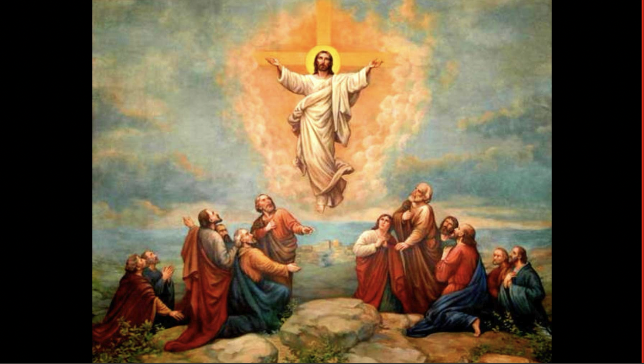
Hello everyone and welcome back to the Matthew Schreiner Podcast. And this episode we will be looking at the Ascension. Now, if you live in most places in the US, the Ascension is celebrated on the Seventh Sunday of Easter. However, if you live in most non-America places, and one of a handful of diocese in the US, the Ascension has been traditionally celebrated forty days after Easter, which is the Thursday of the sixth week of Easter. The traditional practice is easy to understand. The events of Holy Week and Easter are chronological. Holy Thursday marks the events of a certain day in Christ’s life, Good Friday marks the events of a certain day of Christ’s life, and both of these days were on a Thursday and Friday. Likewise, Easter took place on a Sunday. The Ascension, just like the Last Supper, the Death of Christ on the Cross, and the Rising of Christ from the Dead, really and actually happened. The Ascension took place forty-days after easter. The Easter season lasts for fifty days, and officially ends on Pentecost. However, the Ascension took place forty days after Easter, which is why it takes place on a Thursday. However in many places it is moved to the following Sunday. The Ascension is a Holy-Day of obligation, when it is not celebrated on Sunday. So if you are someone who follows the traditional calendar, or live in one of several places where the Ascension is celebrated on Thursday in the US, or you live in one of those fictional non-American places, then you celebrate the Ascension on Thursday, and it is a Holy Day of Obligation. However, for most of you watching this, it is not a Holy Day of Obligation, and is simply just another Sunday mass. Which is why this Sunday’s reading reflection is on the Ascension, and not strictly on the readings, even though we will touch on them.
I think there is a question that some of you might have, what is the difference between the Ascension and Assumption? I think this is a feast that many people have a confusion between these two feasts. Both of these feasts are Holy Days of Obligation. Both of these events are mysteries of the Rosary. But they are very different. First of, one of them has to do with Mary, and the other with Christ. We discussed the Assumption which takes place in August. The Assumption is Mary’s taking up into heaven. Mary was brought to heaven by God in both Body and Soul. The Ascension has to do with Christ. Rather than God doing an action, Christ goes himself up to heaven. And that is the biggest difference. Mary is brought to heaven by God, while Christ is brought to heaven all by himself.
Both the Ascension and the Assumption can both teach us something important, they teach us something of Christian hope. We are called not to simply look at the here below. Christ has not left us alone, but is in heaven. Just as Mary is in heaven. We have hope that one day, first, we will see him in heaven, and second, we will see him at the end of the ages, here upon earth. The Ascension teaches us to have hope, one of the most important Christian virtues. We are not called to seek the here and below, the passing and failing and faltering earthly things, but rather the things of heaven, where Christ is.
For Forty days after his Resurrection, Christ preaches and teaches on earth. And forty days after he is taken up into heaven, in a glorious sight. The Apostles look on in wonder, and they are told that they will see Christ again, and he has been taken up to heaven, and will return in the same way. Paul teaches us “May the eyes of your hearts be enlightened, that you may know what is the hope that belongs to his call, what are the riches of glory in his inheritance among the holy ones, and what is the surpassing greatness of his power for us who believe,”, which reiterates what I have said.
Jesus’s most important words to his disciples are these, and it is what he leaves them: ” Go, therefore, and make disciples of all nations, baptizing them in the name of the Father, and of the Son, and of the Holy Spirit,”. Ultimately, while we are called to seek Christ and where he is above, as we are told by Paul, we are ultimately called to share our hope with all the world. We have mentioned this before. Christ calls us to share out hope. Above all, we are called to bring salvation to all the world.
Christ has not left us alone, and next week we will be reminded of how Christ has not left us alone, but sent us an advocate, sent us something to remain with us, as we continue his mission of salvation, of proclaiming the kingdom of God to all the world.
Today, we are reminded that Christ’s work has been done, and we are called to continue his work in our own times and places. Christ’s ministry concluded, but still continued in the apostles, and continued in those they chose to continue their mission, up until today. We are called to share that hope of Christ, just as those of his apostles and disciples went and shared their hope, throughout the Roman empire, and so on, and it continued through those they commissioned and to ultimately unto us.
The work of Christ, and the work of the apostles, continues unto us today. The Ascension is not the end of Christ’s work, even though his feet no longer walk this earth, even though we no longer hear his voice, even though we unlike Thomas cannot touch his hands and side. Yet we are called to say, like Thomas, “Dominus Meus et Deus Meus”. And we are called to share “Our Lord and Our God” with all the world, and we are called to share this hope unto all the world.
There is a hymn that goes, Go Make of All Disciples. It reminds us that we are called to make of all the world, disciples of our Lord. Making disciples is not only the job of the Pope, not only of the Bishops, not only of the Priests, not only of the Deacons, not only of the religious brothers and sisters, but the job of all the faithful. All the faithful are called to share the faith in their words and deeds. We are called to be examples like Christ and the Apostles. We are called to preach and teach and live good lives just like those of the apostles.
Being Christian does not require us to wear cross necklaces, rather we are called to live all our life like Christ, we are called to take up our cross daily, we are called to live our lives as examples of being Christian. We are called not to necessarily wear physical crosses, but live our lives as the cross. I hope you understand what I am trying to get out. A cross can help, and you are welcome to, it is a great example for others that we are Catholics.
Ultimately, this is also a reminder that we are not called to be simply exteriorly Catholic. We must have an interior faith life. Being a Catholic, being Christian, does not require us to simply wear a cross, or to go to mass on Sunday. Being Catholic, being Christian, requires day to day devotion. It requires prayer, it requires us sharing our own faith. The faith that brings us joy, that brings us hope. We must allow our faith to bring us hope. It is our salvation, it is our escape from death, both physical death, that we will one day live on in heaven, and that we will see once again life at the end of time. It is also salvation from the death that is sin.
We all have struggles, we all have sins. And ultimately it is only Jesus that can take us away from that, that can bring our death to death. For it was in the crucifixion that our sin was nailed with Christ upon the cross. Our sin, our death, was why Christ was put upon the cross. And it was raising again that Christ proved that he was fully human, and fully divine. And it was in raising again that Christ proved the hope that we had in him, that we would see him again in heaven, and at the end of time.
When Christ left this world it was not sadness that Christ and the Apostles were left in at the Ascension. It was peace, it was calm, that Christ and the Apostles felt. Not only that, we are reminded that in a week we will be celebrating the giving of the Advocate and Paraclete by Christ. He promised he would not leave the church alone. That is Pentecost, that is next week. That is the Birthday of the Church. Today, the Ascension is the beginning of the acts of the Apostles, while Pentecost is the Birthday of the Church, today marks a change in the Church, Christ is no longer there. But unlike after the Crucifixion, there is no bitter feelings. The Apostles still have great hope and joy. And next week that joy will be fulfilled. The Church will be born fully. She will then be the fullness of the sacrament of salvation, continuing Christ’s work, Christ’s sacraments until the ends of the ages.
Christ is the light of the nations, and the church and her members are called to bring forth that light to the nations. We are called to be, as Christ says, a light to the world. And the Ascension, reminds us of this.
The Ascension reminds us once again of the hope that we have in Christ. We know that he is our salvation, that we will see him at the end of our lives, and at the end of times. So as a different hymn says: “Go to the world, go our to all the world”. We are called forth to share our faith, to share our hope, to share our Christ, to all the world, to the ends of the world, to go forth baptizing all nations “in the name of the Father, Son, and Holy Spirit”.
Leave a Reply