
Hello everyone and welcome back to the Matthew Schreiner Podcast. And in this episode we are back reflecting on the readings from Sunday. The readings from today are from the Second Sunday of Lent, from both forms of the masses, the extraordinary and ordinary.
In the first reading, of the Ordinary Form, we hear of God’s promise to Abraham that he would make of him a great nation, and that his name will be blessed among nations, and all the earth shall find blessing in him. This promise to Abraham, the promise of his many descendents and a great nation, is ultimatley fulfilled in Christ. Through Christ, salvation is avaliable to all nations. The promise to Abraham, of innumerable generations, is fulfilled in the church, who has shared the message of salvation to all the world, and who has brought to Abraham many spiritual descendents. Not only is this heritage limited to those who are of the Jewish faith, those of Christ’s time, who believed in Abraham’s faith and lived in Isreal, but rather it is offered to all those who believe, to all those who are now descended from Abraham’s faith, that is to Christians of today, who are the numerous descendants of Abraham.
The Second Reading from the Ordinary Form, reflects the same message, Paul writes:
“He saved us and called us to a holy life,
not according to our works
but according to his own design
and the grace bestowed on us in Christ Jesus before time began,
but now made manifest
through the appearance of our savior Christ Jesus,
who destroyed death and brought life and immortality
to light through the gospel.” (Lectionary, USCCB)
Paul says that through Christ we have been called to new life. That through Christ grace and holiness have been poured out upon us.
The Epistle of Paul to the Thessalonians read at the extraordinary reflects this same message: “For God hath not called us to uncleanliness, but unto sanctification: in Christ Jesus our Lord”. The message of Paul is the same in both readings, throught Christ we have been called to newness of life, we have been called to live a life of grace, not according to the works of this world (of which Saint Paul warns against in the letter to the Thessalonians), but the works of Christ.
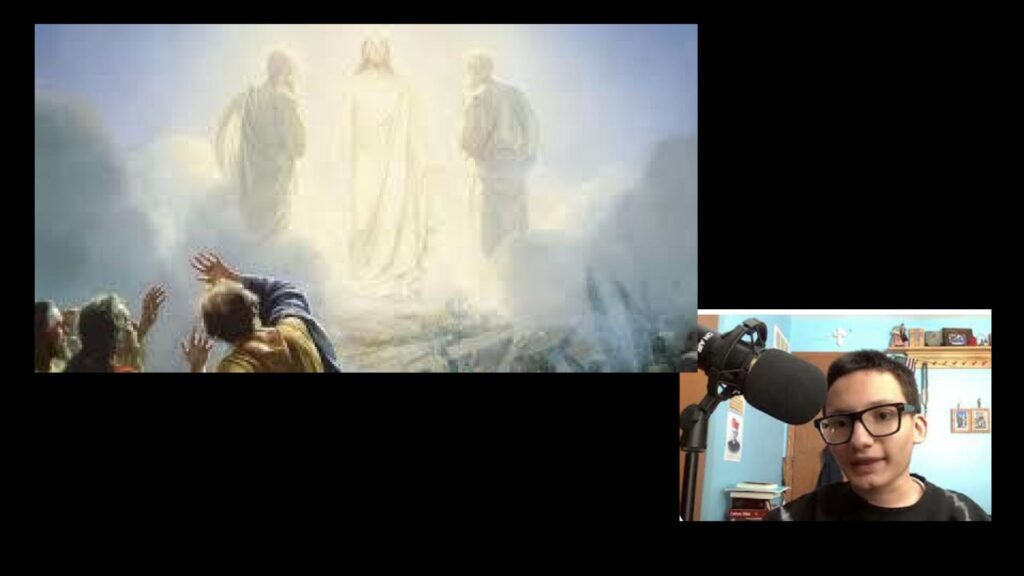
The reason I am able to lump together the Ordinary and Extraordinary Form readings is because the Gospel of both forms is the same. They both come from Matthew, in fact they are the same excerpt of scripture, and they both tell the story of the Transfiguration. The Transfiguration is one of my favorite stories presented in scripture. The Transfiguration is one of the Mysteries of the Rosary added by Pope Saint John Paul II, called the Luminous Mysteries. The Transfiguration is its very own feast, celebrated at a separate time of the year. However there is an importance to it in this time of Lent, in this penitential season.
Let us go step by step and reflect upon each part of the Transfiguration:
Jesus took Peter, James, and John his brother, and led them up a high mountain by themselves.
There are four people in this story, as of now, Jesus, Peter, James, and John. Matthew does not serve as an eyewitness to these events. John, one of the other evangelists, who is called the beloved disciple, is present there. So is Simon, who the Lord called Cephas or Peter. Peter, in the story of Caesarea Phillipi is made the rock upon which the church is built. And there is also James, the brother of John. These men are brought to the mountain by Christ. The mountain is an important scene. We read of several mountains, the mount where Abraham is to sacrifice Isaac, Mount Sinai where Moses receives the law, the Mount Carmel where we read of Elijah. The mountain is a place where one encounters God, man is brought close to the heavens, as the ancient structure of churches recounts, churches were designed to be built tall, “reaching towards the heavens”. Thus the mountain was the most important place where a person could reach God. This sets the scene for the rest of the story.
And he was transfigured before them; his face shone like the sun and his clothes became white as light.
Let’s look for a moments at Moses. Moses has a similiar story, while talking to God his face became radiant, so that, not even the Isrealites could behold it. Moses was made to veil his face. The word adoration comes from the Latin ad – ora literally meaning mouth to mouth. Adoration defines a great closeness. In this we see that Moses not only speaks to God, but speaks face to face with God. We don’t know that Jesus is speaking to God. But what we do know is that he is transfigured, he becomes gleamingly white, like the sun. The sun, that one cannot look at for long, the sun, the brightest thing we can experience.
And behold, Moses and Elijah appeared to them, conversing with him.
Moses and Elijah, who we have discussed before, now appear, they who went to the mountains, now appear to Christ. These prophets who came before Christ. These prophets are not dead, rather they live, not neccesarily in a physically “risen” body, and are now able to converse with Christ
Then Peter said to Jesus in reply, “Lord, it is good that we are here. If you wish, I will make three tents here, one for you, one for Moses, and one for Elijah.”
My question is, how does Peter know who these men are? Peter would not have met either of them. How long this scenes take place, we can’t tell. But, seemingly, Moses and Elijah only speak to Christ. What is the nature of this conversation between Christ and these prophets? What is it that they are discussing? What is it that leads Peter to ask if he should set a place for these prophets? I can’t help but wonder about this. What leads Peter to ask this of our Lord?
While he was still speaking, behold, a bright cloud cast a shadow over them, then from the cloud came a voice that said, “This is my beloved Son, with whom I am well pleased; listen to him.”
While Peter is speaking, a voice, casting a shadow, and we can assume it was greatly bright there with the light we can assume radiated from Christ, is now gone, and from a cloud a voice is heard. And we understand that this voice is from God, speaking of Christ, this is my son, I am pleased in him, listen to him. Be attentive to him. Jesus’s divinity is not only revealed in his shining light, but also in these word of the Father, that he is the Son. We are reminded of the Baptism of our Lord in which he says the same, this is my beloved son. But more than this we are revealed, a beloved son, well pleasing to the father, who we should be attentive to.
When the disciples heard this, they fell prostrate and were very much afraid. But Jesus came and touched them, saying, “Rise, and do not be afraid.” And when the disciples raised their eyes, they saw no one else but Jesus alone.
The disciples were afraid, and we can read this two ways, a fear like when one sees imminent danger, or the fear of the Lord, one of those virtues we are told of. And Jesus seeing the disciples fear, tells them to rise and not to be afraid. And then when they look up, it is only Jesus there.
As they were coming down from the mountain, Jesus charged them, “Do not tell the vision to anyone until the Son of Man has been raised from the dead.”
Jesus does not tell the disciples do not ever tell anyone what you saw, or that this did not happen. Rather he tells them, not to reveal this until the Son of Man has been raised. Jesus speaks several times of the Resurrection throughout the gospels. We can take this as that when Jesus is raised his divinity will once again be vindicated, as it was in this event. Jesus’s divinity is again revealed in the Resurrection, as it was in the Baptism and Transfiguration. Once again in the Resurrection, as in the Transfiguration, Jesus’s divinity is truly shown before the nations.
But more than that the Transfiguration, as with the Resurrection, is a sign for us. It is a message of what we are called, what we can become. And above all in this time of Lent we are called to realize this. There is a song that you may hear, “Transform us as you transfigure”.
The Transfiguration reminds us that we are capable of transforming our lives, of being reformed in the image of God, of transforming our lives. Of becoming better, of becoming Sons and Daughters of God.
Like Peter, we should also wish that our Lord would stay with us, should dwell not within a tent, but within our hearts. We should desire for his message to remain with us, to percolate in our hearts and change our lives. By this also, may Christ, “transfigure” our lives. That we may grow to be like him every day, as Saint Paul writes, that grace and mercy may abound in our lives.
Like Christ, we can become as radiant as the sun, become gleamingly white. Thus in this time of repentance, we are called to turn from sin, as we read in Paul, and called to the greatness of the call, that call, is sainthood, that call is Resurrection, that call, is to be transfigured. As Christ was transfigured on Mount Tabor, we too can be transformed. We too can be radiant sons and daughters of God.
Leave a Reply