
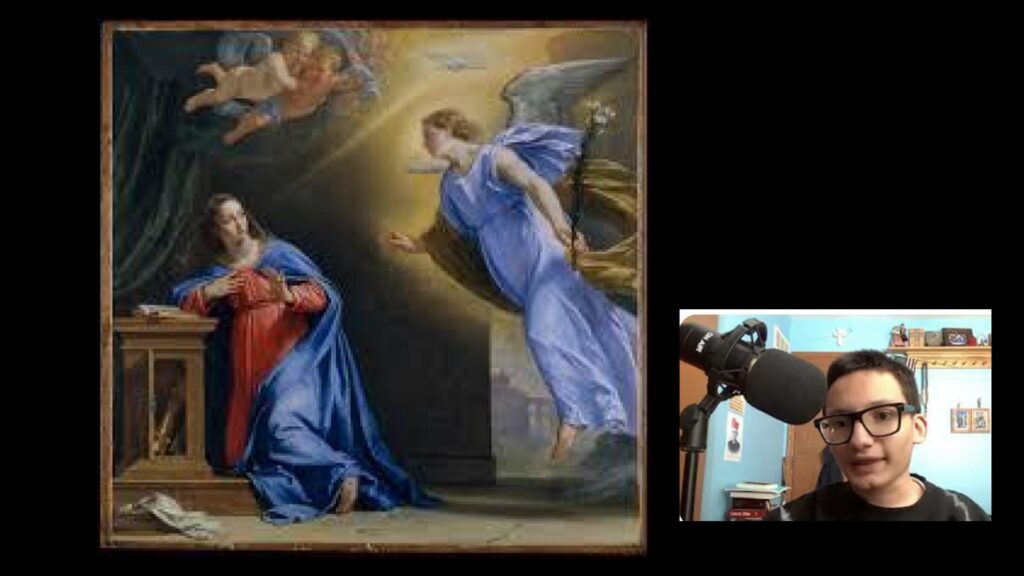
Yesterday, we celebrated the Annunciation of our Lord. I believe that I have previously mentioned that one of my favorite feasts or events is the Transfiguration, but another one of my favorite feasts is the Annunciation. And like the Presentation, the Annunciation is also a mystery within the Rosary. The Annunciation is one of the original 15 mysteries contained in the Joyful Mysteries, while the Transfiguration is one of the Luminous mysteries added to the Rosary by Pope Saint John Paul II. And it is often, in my mind, the forgotten feast. It is, after all, in the middle of Lent. It is always during Lent, and sometimes even falls during Holy Week, and if this happens it is moved to after the Easter Octave.
So what is the feast of the Annunciation? The feast of the Annunciation can be found within scripture, in the account of Mary and the Angel Gabriel. You will also notice that the Annunciation is nine months before Christmas, which makes sense as the human development process in the womb takes place for nine months. Often the Annunciation is confused for the Immaculate Conception. Which make sense, as the reading for the Immaculate Conception is the same as the reading for the Annunciation. Both are the account of the aforementioned visit of the Angel Gabriel to Mary, which is the Annunciation and not the Immaculate Conception. Let us distinguish the two, the Immaculate Conception is the Conception of Mary without sin in the womb of Saint Ann.
What was the need for Mary to be sinless? We can see that Mary is sinless in the greeting of the Angel, “Hail Full of Grace, the Lord is with you”. This greeting puzzles Mary. The reason that Mary was made free from sin, both original and personal, was to prepare her for Christ, that the vessel that would carry the Lord, that would carry God, that would be the Mother of God, would be a pure woman, a pure womb, not stained with any sin. Mary was not sinless so Christ could be sinless, as why would God not have kept Mary’s mother sinless, and so on, as many Protestants object. The reason Mary was sinless, was because she was to be the Mother of God. For Mary the effects of Christ’s cross were applied to her, as God is beyond time. Christ was able to apply the effects of his cross, his sacrifice for us all, to Mary.
God had a plan for Mary, a plan for her from her mother’s womb that she would be the theotokos, or God-bearer, or the mater Dei, mere de Dieu, madre de Dios, mother of God. God’s plan for Mary was that she was to carry in her womb, and bring forth, the messiah. Like Mary, God has a plan for each of us. We read elsewhere in scripture that God has formed us from our mother’s womb, and that from the womb he has known us. We too, like Mary, are called to be obedient to God’s call, such as we read in the Annunciation account, we are called to give our fiat, our be it done to me according to your word, our yes, to God’s plan, just as Mary did in the Annunciation. Like Mary, we are called to bring forth Christ into the world.
The Annunciation is the event, like Christmas, that we recall the Incarnation, the event in which the word became flesh and dwelt among us. Christ did not become a child when he was born at Christmas, rather he became a child, a new and distinct human, God who took on flesh, at the moment of the Annunciation, the moment that the Holy Spirit came upon Mary, and Christ became a new child, though small, within the womb of Mary. Christ like all human children developed in the womb, and after he was born, he grew and developed. Christ did not choose to simply become a fully grown man, he chose to become a child, sharing in all human experiences.
In the Incarnation, we recall the line of John, the line upon which generations have genuflected, on Christmas and at the end of every mass when there was the last gospel, the Word became flesh and dwelt among us. Similarly, we recall in the Nicene Creed, For us men and for our salvation he came down from heaven, and by the Holy Spirit was incarnate of the Virgin Mary, and became man. The Incarnation is the mystery in which God became flesh, God dwelt here on earth, he who is beyond time, entered into time. God enters into our very time line. He takes upon himself our death, in fact he takes upon himself a very human death. He takes upon himself crucifixion, a very bloody, a very painful, a very human death. He experience humanness. He cries at the death of his friend Lazarus. He has a love for his friends and disciples, for his mother and father.
Jesus, the name given to God-made-flesh, to the Son of Mary, the name given by an angel to Jospeh, was true God and true man. He is: the Only Begotten Son of God, born of the Father before all ages. God from God, Light from Light, true God from true God, begotten, not made, consubstantial with the Father; through him all things were made. He became man for our salvation, God took upon himself humanity, in order to save humanity. He took upon himself, most especially on the cross, our sufferings. He chose to be baptized in order to take upon himself our sinfulness, and it is this sinfulness, that he never himself experienced, that he took upon himself and nailed to the cross.
By his death, we were healed, by his stripes, we are made clean, by his wounds, we are made whole. It was upon the cross that the Incarnation, that the Annunciation, are brought to completeness. It is on the cross that the work begun in the Annunciation, in the Incarnation, in the birth in the Manger/the Nativity, it is on the Cross that all these works are brought into completion. The cross was the fullness of the mystery of salvation, but it is not the end.
In fact that work on the cross, in many ways, does not end with Easter, does not end with the Ascension, does not end with Pentecost. Because it is in all these works that the work of the cross are continued. The sacrifice that Christ made is brought into fulfillment in Easter, in the Ascension, and finally with Pentecost. And with Pentecost, the work of the cross is continued till today. Christ’s cross is still as potent, still as present today as it was at Easter, at the Ascension, at Pentecost. It was at Pentecost that Christ left his apostles, left the church, the Holy Ghost, the Paraclete, to remain so that she could spread the message of Christ’s cross to all the world, tout le monde, and so she still does.
We too are called to bear forth the message of Christ’s cross, begun at the Annunciation to all the world, tout le monde. Just as Mary carried Christ in her womb, and brought forth the redeemer who would die on the cross, so we too are called to as Saint Paul says, proclaim Christ crucified. We are called to share God’s message to all the world. We are called to share the message that God so loved the world, that he became man, and died on the cross for our redemption. That for us, God was willing to condescend, to become man, willingly and lovingly, that he sacrificed himself, so that man may become God. God became man, so that man could become God. Christ died for us to open the kingdom of heaven to all who believe in him.
In the fullness of time, Christ became man. He became man for our salvation. He chose to share in our humanity, and shared in all human stages, he chose to share in our joys and sorrows. And that is what we celebrate on the feast of the Annunciation. The feast of the Annunciation, some say, could rightly be called the Feast of the Incarnation. For it is on this day, that the word became flesh and dwelt among us, it is on this day that the Son: For us men and for our salvation […] came down from heaven, and by the Holy Spirit was incarnate of the Virgin Mary, and became man.
Leave a Reply