
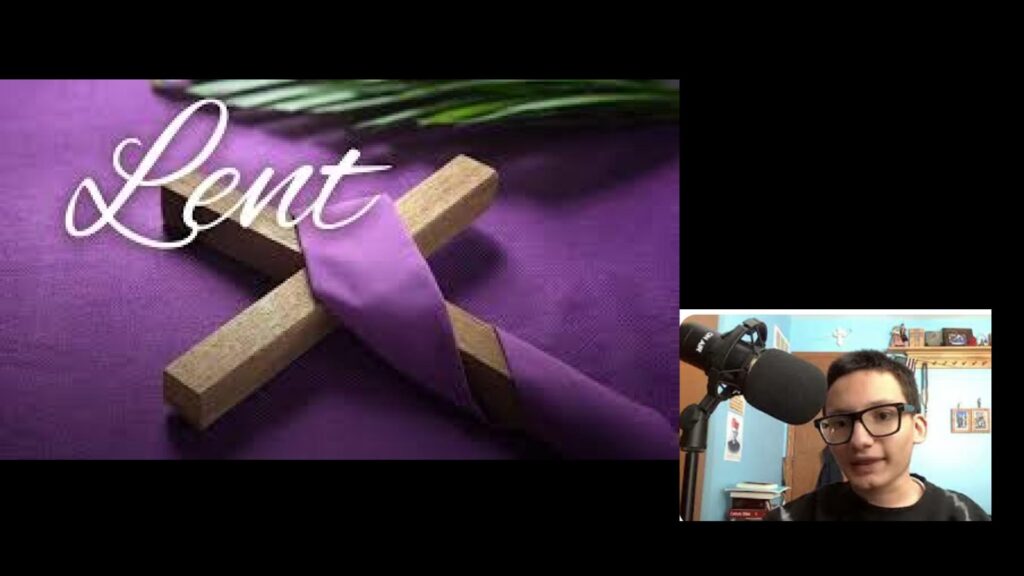
Yesterday, many Catholics went to church, and received Ashes on their Foreheads. Many more Catholics came up with something that they will be giving up. Thus begins the Season of Lent. A season that can be best put as a “retreat”. We retreat from our normal life, and focus on something. What is it that we focus on?
First, I want to start with two jokes. A priest is walking home one night, when he gets stopped by a robber who tells him to give him his wallet. So the priest opens his coat, and then the man sees the collar. He stops the priest. He and the priest talk for a while, and finally the priest reaches into his coat pocket and grabs two cigars and a lighter. The man stops the priest and tells him that it’s Lent he gave up smoking.
An Irish man goes into the Pub every week. And every week he orders two beers. One day, the bartender asks him about this. And the man says that he and his brother would go drinking together, but his brother moved out of town, so every week the two of them order two beers. The bartender likes this and remembers it. A couple weeks go by, and the man comes in long faced and orders one beer. The bartender goes and tells the man that he is sorry for his loss. The man looks confused at the bartender and says, my brother is not dead, it’s Lent and I have given up drinking.
I share these two jokes because I think so many Catholics have a conception of what fasting is. Like the first joke, we know what fasting is, but we do not allow it to make a change in our life.
I think most Catholics have a conception of Lent. And that Conception is how I started this video, going to church to get ashes, and giving something up for forty, asterisk, days. Lent is a forty day fasting season that consists of six or seven weeks. Six full weeks, preceded by the days after Ash Wednesday. The reason the days of Ash Wednesday were added was to ensure that there were 40 days. Sundays do not count in Lent, if we count Sundays it is 46 days. Then, generally, the Lenten fast extends during Holy Week and through to Holy Thursday. With Good Friday, and Holy Saturday having their own fasting rules.
So why do we do this? We touched on this in the last episode. But for most people, I feel, these Lenten practices are only superficial. And I don’t want this attitude to be as commonplace as it is. The biggest reason I want to share this, is because there are large numbers of Catholics who at least get the idea. They understand that there is some kind of importance behind this Lenten season. Why else do they show up at churches on Ash Wednesday? Why else do they fast from meat every Friday? Why else do they give something up for the season of Lent? They understand that there is something important.
Fasting seasons are important for many. For example, the Moslem’s have a fasting season that they call Ramadan. Fasting is something that is spoken of in the scriptures. In the last episode we talked about the forty-day fasting of Moses, Elijah, and Jesus. And each of these was used for preparation for something important that God was about to do through or for them. Besides this, forty is an important biblical number. The Israelites were kept out of the Promised Land for forty years. Noah was in the boat for forty days and forty nights, besides also remaining in there forty more days. Forty, then, is a number of completion.
Jesus also teaches that fasting is something we should do. Not only does he himself fast for forty days, but he even tells his apostles what to do when they fast. Note this, he does not say if you fast, but when you fast. He never says you should not fast. But why do we fast? I kind of touched on this in the Lenten episode. We fast to draw ourselves closer to God, by allowing our appetites to be drawn to him. When we hunger or remove something from our lives, it gives us time and draws us to God. When we remove something from our lives, like giving up for example social media, we can better spend this time in prayer.
Prayer is a pillar I want to stress. Prayer is how we communicate with God. Prayer allows us to draw closer to God. So during this Lent, we should increase our prayer. For example, Stations of the Cross. Stations of the Cross are a traditional Catholic practice that allows us to be drawn closer into the sacrifice of Christ on the cross, the sacrifice that won for us our redemption. During this season, the Sacrifice of Christ is especially recalled as we both prepare for Good Friday and for Easter. Good Friday is the day of the Passion of Christ. On this day, no mass is celebrated. This is a long tradition of the church. In the pre-1955 reformation of the Missale Romanum a large consecrated host was saved from the Mass of Holy Thursday, and in the Missal Romanum post 1955 reformation, the 1962 Missal, and the Missal of Paul VI, or the Novus Ordo Missae, hosts from Holy Thursday are distributed to the Congregation. However, no consecration is to take place on this day. Such a distinction does not matter for our discussion of Lent, and the peculiarities of Holy Week and the Pascal or Easter Triduum will be discussed later on, during Holy Week.
Fasting is important, but it should not be divorced from prayer. I think so many Catholics, whether they realize it or not, understand the importance of fasting. They do it. But often I feel they only do it because that is what they were taught. They do it, only at face value. If we want a lent that is transformative, that allows us to grow deeper in our faith. Prayer is the most important pillar. One must pray in order to make their fast effective. One must pray if they wish to have a good Lent.
Above all, if simply giving something up is all you do for Lent. Then that won’t have an effect once Lent is over. Above all, Lent is, as it were, a time to propagate new growth in our spiritual life, to plant spiritual seeds. Does giving up soda or candy or anything else, actually have an effect on the spiritual life? Not necessarily. But propagating good spiritual habits, that can start in Lent, and continue throughout the spiritual life, is something that does have an effect on the spiritual life.
Fasting is, again, an old practice and one practiced by many faiths. Fasting is not unimportant. Ultimately, our days of fasting have been brought down to only two, with the older practice being every day. Fasting is a requirement for those 18 plus, or 21 plus. The church does not bind you to fasting on the forty days of Lent, however, one can choose to celebrate the forty day fasting, if one so chooses. This fasting, up until 1966, was only two small meals and one large meal. This does not apply to those who are 18 and under on Ash Wednesday and Good Friday. Abstinence from meat is only applicable on Fridays and Ash Wednesday for age 14 plus.
Regardless, our fasting should come alongside prayer and other good faithful Christian practices. When we give something up, that should come only as a benefit to our faith life, not as a simple meaningless practice. Which I do want to note, the church does not say we must give something up. This is by no means a requirement of the church. Rather it is a penance we do, and often Penance is done in place of fasting and or abstinence, as is the rule with meatless Fridays.
Additionally, so many see an importance to Ash Wednesday as the start of Lent. However, it is not a Holy Day of Obligation. Which is unlike the other days that many Catholics, nominal Catholics we will say, attend, which is only Christmas and Easter, with my addition of Palm Sunday. However, there is a recorded influx of people at Ash Wednesday masses.
So, I think there is something important about Lent, about this season of fasting. But we cannot let this be the end of our faith, rather the beginning. It should not be the only thing we do, but the start of a profound change in our lives. Don’t come for one day, come every week, come every Sunday, and allow that to permeate into daily life. Allow prayer to be a pillar of our lives, not only in Lent, but all the time.
That’s what I want to stress about Lent. These Lenten practices are great, but only if they inspire us to live a better life beyond the forty days of Lent.
I thought this was an important thing to look at. That we should all draw deeper into our faith, and Lent is a great time to begin. Many understand the importance of Lent, but seemingly understand it only at face value, and do not allow it to make a difference in their lives. Lent should be the start of a better life, of deeper devotion.
God Bless, and see you next time!
Leave a Reply