I was shared this article by a theology teacher, called “Is Leonine Unity Even Possible?“, and I thought it would make for an interesting episode.
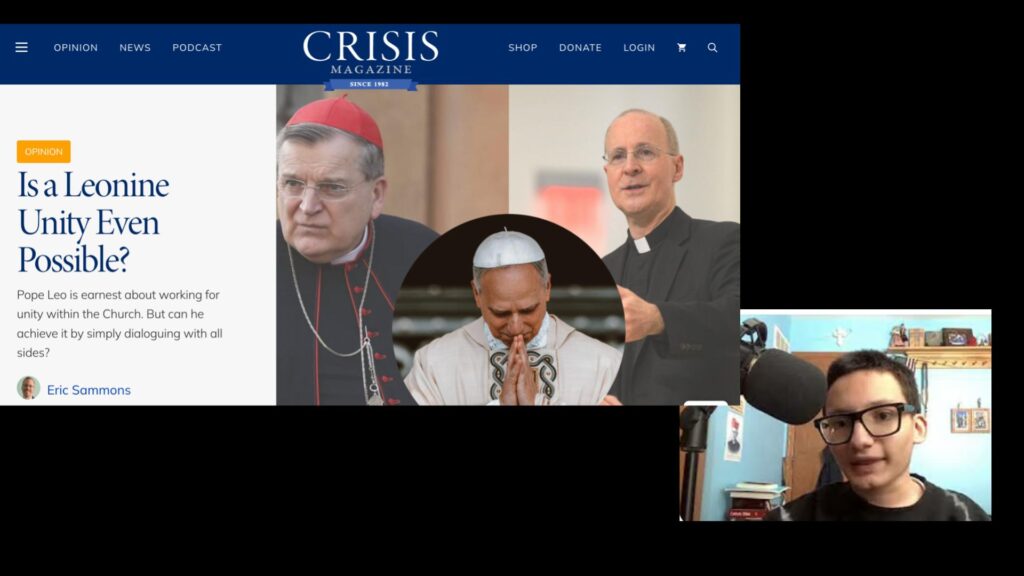
The cover of the article shows images of Cardinal Raymond Burke and Father James Martin, with an image of Pope Leo in the middle. The subtitle of the article is: “Pope Leo is earnest about working for unity within the Church. But can he achieve it by simply dialoguing with all sides?”
Most recently, Pope Leo has met with the FSSP, but obviously, what is being shown is the two different sides, Cardinal Burke a very traditionalist and orthodox bishop, whom Pope Leo met with, and Father James Martin, a rather heterodox priest, who advocates for LGBT in the church.
The article says that we can see one of the thing Pope Leo sees as important for the church is unity, within the church. The article says that Leo’s efforts for unity in the church are clearly seen in the communications he is willing to have with figures in the church, like Cardinal Burke and Fr. James Martin, who, seemingly, are polar opposites of clerics in the church, who advocate and view things in rather different ways. The article says this: “the pope seems intent on listening to every perspective within the Church. He’s committed to bringing those with diverse viewpoints and worldviews together in order to end—or at least reduce—the fierce battles raging among Catholics. It’s a noble goal, and it makes sense that this is a papal priority.”
The article points out how it is hard for Catholics not to use adjectives like “conservative”, or “liberal”, or “traditional”, or in Father Martin’s case, “LGBT”. And I will not disagree, many Catholics feel the need to call themselves “trads” or other titles. I honestly, dislike using such titles, because I feel it is no different than blue haired liberals who put pronouns or flags in their online bios, or other descriptors they feel they need to use. But, I digress.
The article says that Pope Leo wants to be a true “pontifex” or “bridge-builder”. The article asks, however, can such a unity be made between Fr. Martin and Cardinal Burke, that they are not just in communion with the pontiff, but with each other.
At this point, I would like to point out an insight that this teacher shared, the difference between unity, and diversity. Diversity itself includes division. Where we feel the need to fill some kind of quota, of having different kinds of people. Unity, instead, is built upon viewing people as one not because of their differences, but in spite of their differences. Diversity, says we need to include everyone, unity, says everyone should be included. I know those seem like their the same thing, but I think there is a difference. Diversity, seemingly, treats people as a quota, as a statistic, as a number. Unity, treats people as one statistic. When we speak of the unity of the church, we do not, and should not, divide people, all are Catholic. All are one, all are human. We do not see race as something that divides us, because, we are all members of one humanity. Diversity, seeks to say, we are all human, but we exist divided from each other. But, again, I digress.
The article continues, the key to lasting unity, is truth. Unity requires that people agree on fundamental truths. Let’s take for example, marriage, in which a union, or unity, is created, where two become one flesh. If two people disagree on fundamentals of marriage, then, such a marriage will not last. However, little disagreements, like what to have for dinner, should not serve as a roadblock to marital union. If people in a marriage disagree on something as fundamental as birth control, the lasting union in a marriage, the purpose of the marital act, and other fundamentals of the marital union, then such a marriage cannot last. That is an example of simply union, I think most will understand.
For Catholics, a union exists because we believe in fundamental truths. For example, when I went to France, the first place we stopped was Saint Malo. Saint Malo is a beautiful port town, with a little, what you might call “downtown” area, which looks like an old town, though it was completely destroyed in the Second World War. The first place I stopped was a Cathedral in town, whose doors were opened. And, in away, a Catholic, even like myself who is not French, but even I could feel, “at home”. Or when we were in Paris, and attended Vespers at the Sacre-Couer Basilica, I still felt at home. I knew the order of this service, I knew the Latin hymn, Veni Creator Spiritus, I understood the psalms, because it’s the same ones we read here. When we attended mass at Notre Dame Cathedral, I felt at home. And I knew the Latin chants of the Kyrie, Gloria, the Credo, and the other mass parts.
That’s something special about Latin, the still language of the church, which the mass and it’s parts are intended to be, as Sacrosanctum Concilium, the Second Vatican Council’s decree on the liturgy says. Latin unites Catholics, into being able to join in the celebration of the mass, even in a far away place, because, if we are properly taught and understand the mass, we are able to join in and now these words. Or if we know the chants, the same thing.
I hope this serves as a good example of unity, for Catholics. And, I don’t think the same thing exists for many protestants. For sure, Anglicans, for example, do have one common book of prayer, or the Common Book of Prayer, and an Anglican at St. Paul’s Cathedral in London, could experience a similar service to one in America. However, the same cannot be said for many evangelical services, who place more of an emphasis on the word’s said by the preacher, than a service centered around the Lord’s Supper, as many other protestant services, like Lutherans or Anglicans. Regardless, amongst most protestant’s there is not a unity of belief around worship. For example, you can go from an Anglican to Episcopal church, rather easily, and experience, the same “liturgy”, and maybe from an Anglican to Lutheran or Episcopal to Lutheran, maybe you can have a similar experience. But what about from a Anglican to Evangelical, or even Anglican to Baptist or Presbyterian, where instead of emphasis being placed on what the ministers does, i.e. the Lord’s Supper, the emphasis is placed on what the minister says. The problem for Protestantism in general, is this unity of worship, which Catholics, at least in theory, have.
And even then, for Catholics, unity comes in two ways, the first is Communion with the pope, and the second is communion with one another. When I went to Paris, it was the vespers that should show you communion with the broader church, rather, it was what we were before, the Blessed Sacrament, which at this Basilica, is in perpetual adoration. Or when we went to mass, I received this same Lord, present there at the Basilica in the Monstrance, but just as present in the Eucharist I received at that mass, and at the mass every Sunday at every parish in my diocese. The Eucharist is the ultimate source of communion between Catholics, not any liturgy or liturgical practices. Jesus is as much present at my Roman Catholic mass, at the Novus Ordo or TLM, as he is at a Maronite Catholic, or Ukrainian Catholic, liturgy.
Back to the article, it says this: “This inherent relationship between unity and truth is why both schism and heresy have always been the two great evils against Catholic communion; neither can be allowed for a full flourishing of the Church. Historically, the East and the West have emphasized the importance of these twin evils in different ways. The East has been willing to be more flexible when it comes to schism, while being far more adamant about not allowing heresy. The West, on the other hand, has been more adaptable to heresy while fighting tooth and nail against schism.”
I had never thought about this difference between Catholics and Eastern Orthodox. Catholics are willing to fight for a common union, or communion, especially under one visible authority, the pope. Where as Orthodox, are more concerned with having a concise theology. The West are more tolerant of heresy, while the east, are more tolerant of schism. There exists one such Schism, this article points out, between Constantinople and Moscow, where as Catholics are more lenient of heresy, form the pulpit to the pew. The article points out, that, regardless, true unity does not exist.
To bring up a different issue, is true union of all Christians possible? What truly divides all Christians is not doctrine, though true, it is ultimately who is the ultimate authority. What divides Presbyterians from Episcopalians, is church governance, clearly seen in their name. One stresses the authority of the local congregation, while the other stresses an importance on more regional governance. The difference of presbyters and bishops (or episcopates). The things dividing most Christians, is who is the authority who can decide what is permissible, especially in terms of doctrine. Who decides what is right? The bishop, the local ministers, the pope, the patriarch, or each individual? This is the ultimate division amongst Christians. Who decides what is right?
Back to the article, again, I think this part is important, “Pope Leo is part of a generation of Catholics that took the Western emphasis of unity over truth to a harmful extreme. For Catholics who came of age during the 1960’s and 1970’s, unity in appearance became the driving force behind everything while truth was thrown into a back closet. We can see this in the overemphasis on the ecumenical and interreligious dialogue movements. Too often Catholic leaders have been willing to jettison important and uniquely Catholic truths to achieve “unity” with non-Catholics,”
He continues to touch on this in saying of Father Martin: “The reality is that unity between a Fr. James Martin and a Cardinal Burke is not possible without repentance on the part of Fr. Martin and those aligned with him. Those who teach error must repent for their rejection of Catholic doctrine on topics such as human sexuality and the sacredness of marriage between one man and one woman for life.”
If we want to reach true unity, we must have, what I was taught, what Cardinal Bernadin called, the “seamless garment”. Ultimately, Christian unity should unite Christians into a “seamless garment” or what Saint Paul calls the “body of Christ”. A body is one, though many parts. Each part serves a purpose, but it ultimately works to help the one body. We must agree on what our purpose is. And ultimately, that does involve how we view something as inseperable from the truth, as marriage. What is the purpose of marriage? Is it something sacred? Ultimately, Christ teaches us the truth of marriage in the gospel. That marriage is between one man and woman, whom God hath joined together, and which God hath made one, no one can separate.
And as Brian Holdsworth and myself like to point out: “The progressive camp must also come to a recognition of the real purpose of the Liturgy in general and the Mass in particular: only through the Eucharist is true and lasting unity achieved.”, as I mentioned before in this video and others, and which Brian Holdsworth has also pointed out in some of his videos, the importance of the liturgy.
And finally, as I mentioned before: “progressive Catholics need to recognize that there is only one truth and that it is not relative.”. The church has always taught certain truths, and these truths cannot be changed at the whim of ourselves. This includes things like abortion, marriage, contraception, divorce. These are set in stone Catholic beliefs, that will not change just because they fit or don’t fit our feelings.
“until there is an acceptance of basic Catholic doctrine by all parties, unity will not happen.”, the article continues to outline the importance of excommunication, not as a banishment, but a punishment, meant to draw someone into repentance.
Unity is important, and we should strive for unity, but that unity will not be reached until we know what we are reaching. And that ultimately that is the truth. The point of the church is to draw us closer to God, who is ultimate truth. Therefore, we must agree on the truth. Not all things are clear and cut in stone, but things like marriage, are. And so, are things like the liturgy.
So, is unity possible. Yes. But we must understand where unity is. And that is why we have a visible head, with which we can be united, the Pope. Unity is not some abstract thing, rather we can achieve it, under one head, who determines what we believe. Not some mindless submission, because truth, ultimately comes from God, but when judgement needs to be made, we have been given a magisterium.
Coincidentally, this Sunday’s readings had to do with unity. Paul tells the Corinthians about people who say they belong to a whole bunch of different figures in the church. Ultimately, they must agree with each other, and say they belong to Christ, there must be no dissension among them. This reminds us of unity and agreement, as we have discussed here today. Besides that, Christ also begins his mission, reading the scriptures that speak of those who have seen a great light. We also read of the need to repent, and we hear of Christ calling his first believers.
Leave a Reply