
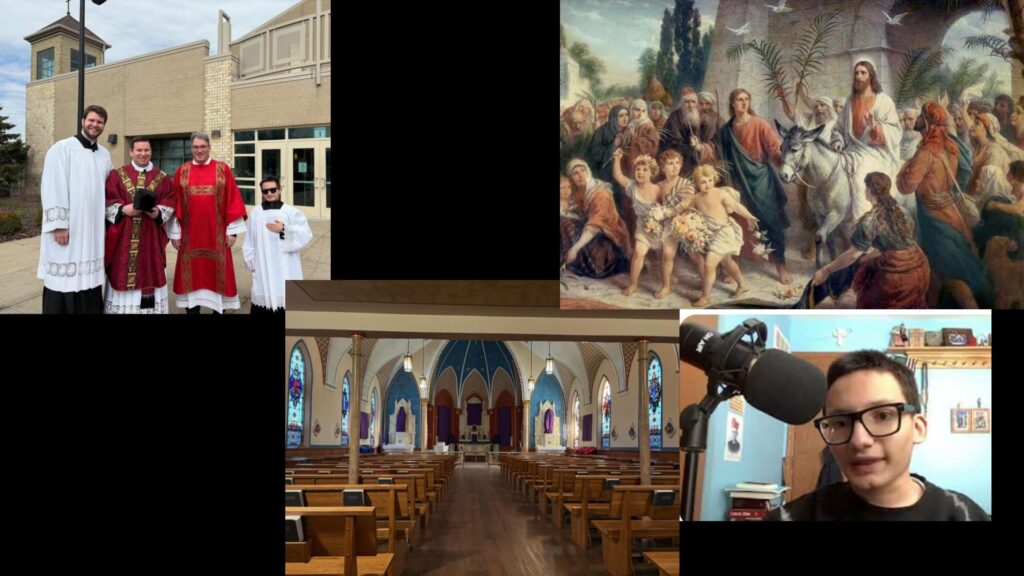
Hello everyone and welcome back to the Matthew Schreiner Podcast. And in this episode we are going to look at Holy Week. Previously, we looked at Lent, and we looked in depth at it. And in this episode we are going to do the same thing for Holy Week. Previously I have given looks at the days of Holy Week, last year. (https://matthewschreiner.blogspot.com/2025/04/holy-week.html) But in this episode I want to give an in depth of all the practices and history.
Holy Week is the week leading up to Easter. Each of the days marks something different. Palm Sunday commemorates Christ’s entry into Jerusalem. Spy Wednesday or Holy Wednesday commemorated the betrayal of Jesus. The next days are referred to as the Triduum. Holy Thursday or Maundy Thursday commemorates the Last Supper. Good Friday commemorates the Passion and Death of Jesus. It concludes with Christ’s descent into Hell on Holy Saturday.
Holy Week is a moveable observance, that is, it does not take place on a set day. Unless you are Palmarian. That’s correct the weird fringe Catholic break off group that started in Spain, they actually have a set date for the celebrations, that take place around March 24th. In the West, Holy Week is the sixth and last week of Lent, similarly beginning on Palm Sunday and ending on Holy Saturday.
Good Friday is the death of Christ, which is believed to be at 3 pm. Christ remained dead until early Sunday morning, this is on Easter Sunday. During this time it is also believed that Christ descended into Hell. Easter Sunday marks the beginning of Eastertide or Easter Week or the Easter Octave. The Easter Vigil includes the chant the Exultet. The Exultet speaks of Christ’s descent into hell: “This is the night, when Christ broke the prison-bars of death and rose victorious from the underworld.”. In fact, a whole reflection could be offered on the Exultet alone. The Exultet speaks greatly of the importance of the night, of the importance of Christ’s passion. Reflecting on the Exultet, however, is not within the scope of this video.
While reading for this, it says Holy Week liturgies tend to draw a great crowd. This is especially true of Palm Sunday, but I am not sure about the other days. Easter, however, draws the greatest crown, however, it is not a part of Holy Week. However, Palm Sunday does draw great crowds, as most people want palms for their house. There are many other non-liturgical practices that take place. Including reenactments of Christ’s passion. As well as movies that do the same.
The history section on Wikipedia begin with the Apostolic times. However, the history of Holy Week goes to the Jewish times. In fact the hint that it goes back to Jewish times can be found in the Easter Exultet: “This is the night, when once you led our forebears, Israel’s children, from slavery in Egypt and made them pass dry-shod through the Red Sea.”. The hint is also in Holy Thursday, Holy Thursday is the night in which Christ celebrated the Last Supper. This Last Supper was a Passover dinner. Christ was celebrating the Passover Sedar dinner with his disciples.
The Easter Exultet also draws connection between the Exodus and Christ’s sacrifice. That Just as the Israelites passed through the Red Sea, so Christ passes through death, he passes through hell and redeems all, and this is the connection made in the Exultet. It draws connection between the two events, that the Israelites in the Red Sea are a prefiguration of Christ.
The earliest references come from the apostolic age of the 3rd and 4th century, and refer to certain fasting rules. The earliest day of important was Good Friday, then the “Great Sabbath” or Holy Saturday, with the vigil being an expectation the Second Coming that would happen on Easter Day.
Palm Sunday or Passion Sunday commemorates Christ’s entrance in Jerusalem, recounted in all four gospels. Christ’s entry to Jerusalem was marked with the waving of palm branhces and the sings and shots of the crowds. This day is often marked first with the blessing of palms, or other branches, such as olive branches, but palms are the most common, and most, if not all, parishes will have palm branches. After this follows the account of Jesus riding on a donkey, fulfilling the prophecies of old. After this, comes the entrance into the church. There was a reform in 1955, that changed the structure of the blessing that took place for the palms. I took a look at the difference between the 1962 missal and the 1954 missals on my other blog Liturgical Review. I will leave a link to this in the description as well as on the blog: https://liturgicalreview.blogspot.com/2025/04/holy-week-54-62.html). I’m sure there are a few of you that might be interested in this, otherwise, I am attempting only to look at the history and details of Holy Week. After this follows the mass, at which the Passion gospel is read.
During Holy Week there is also the Chrism Mass. At the Chrism mass, priests from around the Diocese meet with the bishop at the Cathedral. At the Cathedral they bless the oils used throughout Liturgical celebrations. The priest’s also have what they call a Renewal of Priestly Promises. This generally takes place on Holy Thursday, but it is often moved earlier. Holy Thursday is also considered the creation of the Priesthood, as it is when Christ celebrated the Last Supper.
Holy Thursday is also known as Maundy Thursday, as it is when Christ washed the feet of his Apostles, called the Maundatum. It is also the beginning of the Paschal Triduum. In the Church there is the washing of feet, were twelve peopls’s feet are washed. The Mass of the Last Supper also commemorates the Last Supper, the Institution of the Eucharist and the Priesthood. During the Gloria Bells are rung, and from this moment on, bells are not used. Traditionally, a wooden clacker is used in place, until the Easter Vigil.
Good Friday commemorates the Crucifixion of Jesus. At the Liturgical Celebration, which is not a mass, Hosts from the Mass before are used. There are other practices, especially within different cultures and regions. One such is Stations of the Cross, a practice done during most of Lent as well. On this day there are also, generally, no decorations in the church, and no cloths on the altar, until the Eucharistic service, when a corporal is placed on the altar.
On Holy Saturday, the church remains barren, until the Easter Vigil, when there is restrained joy, and Easter celebrations have begun. On all these days there is no celebration of the mass, except for the Chrism Mass and Mass of the Lord’s Supper and the Easter Vigil. The Easter Vigil is composed of Three Parts: The Service of the Light, Liturgy of the Word (which is longer with several readings), the Liturgy and Baptism and Confirmation, and the Liturgy of the Eucharist. This liturgy takes place after dusk, and the Liturgy of the Light consists of a lit and blessed fire, then being used to light the Paschal Candle, which is then processed into the church and vigil candles are lit from it, then after this comes the Easter Exultet, chanted by a deacon. This lighting process is symbolic of the “light of Christ” as is said several times within this quarter of the mass. The Liturgy of the word consists of several readings, nine readings (though this number is generally lessened) of the Old Testament, followed each by a Psalm or Canticle, then the Gloria, then One New Testament Epistle, and the Gospel, preceded by a triple Alleluia, generally intoned by the priest, followed by the normal allelia by the choir. Following the homily, is the baptism liturgy, and then Confirmation liturgy, and then the normal service of the Eucharist.
Holy Saturday, the Easter Vigil, that is, marks the beginning of the Easter Season. Which takes place for 50 more days. As well as the Easter Octave that lasts for seven days. We will be looking at Easter next week.
I want to share this, there is one saint’s writing I read, in which they say we should become like the garments and palms thrown on the grown in front of Christ to welcome him into Jerusalem. I wanted to share that here. As we read of the crowds acclaiming Jesus in Jerusalem, we should be like them, acclaiming Christ not just with branches, but with our hearts. And that is what this week should do, it should invite us to go deeper into the mystery of Christ’s passion.
Leave a Reply