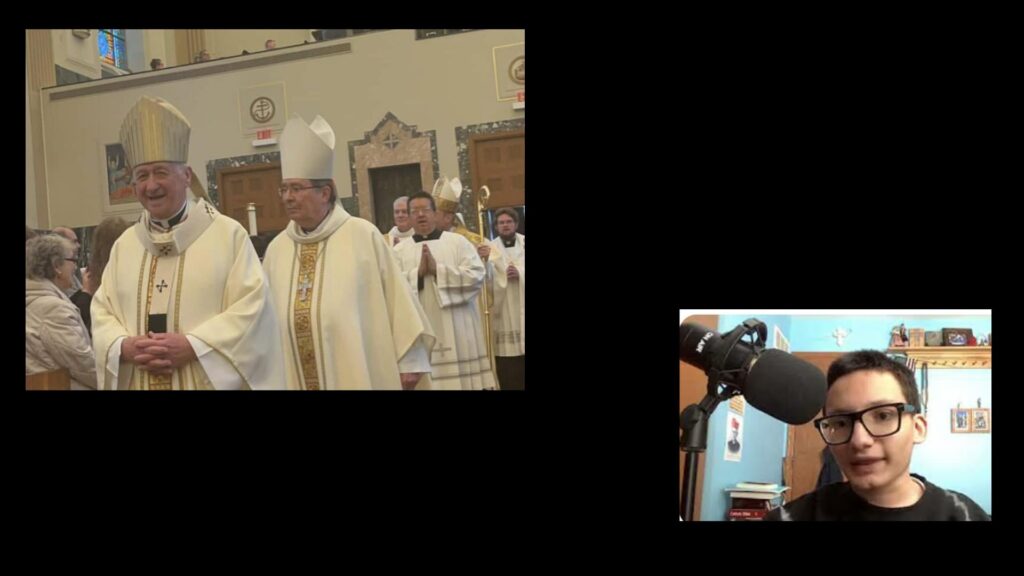
Hello everyone and welcome back to the Matthew Schreiner podcast. Recently, Cardinal Blasé Cupich of the Archdiocese of Chicago, was popular on Catholic Twitter, after statements he made about the liturgy. In this episode, let’s explore what Cardinal Cupich said, and see what the backlash is about.
His point of discussing the liturgy is because of the recent consistory held by Pope Leo XIV, which discussed four topics, the only one we are concerned about is the liturgy. Cardinal Cupich discusses the points made Cardinal Roche, the prefect of the Dicastery for the Worship and Discipline of the Sacraments. Cardinal Roche notes: “The history of the Liturgy, we might say, is the history of its continuous ‘reforming’ in a process of organic development.”.
From the beginning, it is undeniable, that the liturgies of east and west, have developed, from the meeting of the early church, into the Divine Liturgies and Masses of the Rites of the Church. This development has been organic, however. A point about the Novus Ordo, is that it introduced inorganic development. That it took what had been developed over almost 1900 years of Church tradition, and did away with a lot of it.
Why is reform essential to the liturgy? Asks the Cardinal, because, the Cardinal continues, “the ritual component of the liturgy is characterized by cultural elements that change in time and places. Thus, with the passage of time and changes in the culture, there is always a need to reform the liturgy. ” He quotes Pope Benedict about the reforms of the Second Vatican Council that, [they] “do not threaten fidelity to the tradition of the church, since the tradition is not a matter of “the transmission of things or words, a collection of dead things” but “the living river that links us to the origins, the living river in which the origins are ever present””
He then talks about the creation of the Tridentine Missal: “St. Pope Pius V’s motivation for reforming the liturgical books in accord with the mandate of the Council of Trent. It was his desire to preserve the unity of the church. In issuing the Roman Missal of 1570, the saintly pope affirmed that “as in the Church of God there is only one way of reciting the psalms, so there ought to be only one rite for celebrating the Mass.””
“Again, as in keeping with his predecessor St. Pope Pius V, there must be only one rite as a means of preserving the unity of the church.” – and this particular line is where many people had issue with.
He concludes this article: “The two main takeaways in reading Cardinal Roche’s remarks are first, the nature of liturgy itself calls for ongoing reform, and second, that accepting the reform authorized by the church is a matter of preserving the unity of the church as St. Pope Pius V stated, a truth the late Pope Francis recalled.”
Complicit Clergy released an article in response to Cardinal Cupich’s article. The subtitle to the article is: “In his approach, tradition seems to become an elastic concept, defined more by the present than by the received heritage.”
Complicit Clergy says that: “Cupich starts from the premise that the liturgy is not a static reality, but a living reality that has undergone reforms throughout history. However, the way he develops this assertion reveals a conception of tradition that can be considered reductive. Tradition is presented almost exclusively as a process of cultural adaptation, minimizing its normative, received, and binding dimension.”
Complicit Clergy is actually quoting a much longer article from Infovaticana:
The Infovaticana article says: “This reading [that of Cupich’s article] omits a fundamental fact: historical liturgical reforms, including those of Trent and Vatican II, were always understood as organic developments that respected the substantial continuity of the rite, not as abrupt substitutions or breaks with the preceding form. With the generic appeal to the “history of reform,” Cupich seeks to justify any change, even those that impoverish the liturgical experience and break the living transmission of the faith. One of the axes of his article is the assertion that the liturgical reform following the Second Vatican Council constitutes the unique expression of the lex orandi of the Roman Rite, an idea closely aligned with the logic of Traditionis Custodes. Cupich defends that the unity of the Church requires a single rite and that the coexistence of different liturgical forms endangers that unity.”
The article points out that he has a fundamental misunderstanding: namely that the church has existed for centuries in different rites and uses. And these differing rites and uses has never stood opposed to ecclesiastical communion. The article says that treating liturgical uniformity as the only necessity for union, has never been how the church has defined her unity or universality, that is, her catholicity.
The article then points out that the liturgy is not just a tool to control and order ecclesial life, but is truly a way to live out a mystery of salvation. The article states: “The crisis of participation, the banalization of worship, and the loss of the sense of the sacred are not explained by an excess of ritual diversity, but by a deficient application and, in many cases, ideologized implementation of the reform.”
And the article ends by saying: unity without truth is not unity. A previous episode of the Matthew Schreiner Podcast explored this, in regards to a Leonine unity, or a unity brought by Pope Leo, between differing factions of the Church.
The article says: “The unity of the Church is not built by suppressing legitimate expressions of tradition, but by rooting the faithful in the received faith. When the liturgy ceases to be a place of clear transmission of the deposit of faith, it becomes a space of permanent conflict.”
The last article where we discussed unity talked about how truth of the church also involves truth in the liturgy. The liturgy is something that should unite all Catholics, but as I point out, true unity comes in reception of the Eucharist. And on that note, all Catholics, be they Roman, Maronite, or Byzantine, etc., all agree in the fundamental truth, that the Eucharist is the Real Presence of Christ. That when we receive the Eucharist, we receive, the Body and Blood of Christ.
Liturgical rites, that is, the books or rituals that make up different rites, and uses of the liturgy, are all centered around one common high point: the Eucharist, and all seek to give the Eucharist it’s common reverence.
Besides the letters of Paul, the often considered earliest reference to the liturgy is that of St Justin Martyr. Here is Justin’s description of the Sunday meeting: “And we afterwards continually remind each other of these things. And the wealthy among us help the needy; and we always keep together; and for all things wherewith we are supplied, we bless the Maker of all through His Son Jesus Christ, and through the Holy Ghost. And on the day called Sunday, all who live in cities or in the country gather together to one place, and the memoirs of the apostles or the writings of the prophets are read, as long as time permits; then, when the reader has ceased, the president verbally instructs, and exhorts to the imitation of these good things. Then we all rise together and pray, and, as we before said, when our prayer is ended, bread and wine and water are brought, and the president in like manner offers prayers and thanksgivings, according to his ability, and the people assent, saying Amen; and there is a distribution to each, and a participation of that over which thanks have been given, and to those who are absent a portion is sent by the deacons. And they who are well to do, and willing, give what each thinks fit; and what is collected is deposited with the president, who succours the orphans and widows and those who, through sickness or any other cause, are in want, and those who are in bonds and the strangers sojourning among us, and in a word takes care of all who are in need. But Sunday is the day on which we all hold our common assembly, because it is the first day on which God, having wrought a change in the darkness and matter, made the world; and Jesus Christ our Saviour on the same day rose from the dead.”
“And this food is called among us Eucharistia [the Eucharist], of which no one is allowed to partake but the man who believes that the things which we teach are true, and who has been washed with the washing that is for the remission of sins, and unto regeneration, and who is so living as Christ has enjoined. For not as common bread and common drink do we receive these; but in like manner as Jesus Christ our Saviour, having been made flesh by the Word of God, had both flesh and blood for our salvation, so likewise have we been taught that the food which is blessed by the prayer of His word, and from which our blood and flesh by transmutation are nourished, is the flesh and blood of that Jesus who was made flesh. For the apostles, in the memoirs composed by them, which are called Gospels, have thus delivered unto us what was enjoined upon them; that Jesus took bread, and when He had given thanks, said, ‘This do ye in remembrance of Me, this is My body;’ and that, after the same manner, having taken the cup and given thanks, He said, ‘This is My blood;’ and gave it to them alone.”
Justin Martyr describes what Early Christians did. And this very much is similar to what Catholics, be they East or West, do. And his description of the Eucharist, is a very Catholic one. Similar descriptions of the Eucharist are given by St Paul in his letters.
The liturgy has always existed in different uses, and rites. And these are example of true organic development. Look at the Roman Rite, which has many different uses of the Roman Missal, before 1570. The church had different rites approved by the local bishop. And it was the 1570 Council of Trent, that sought to unify the church into one common rite, under the Missale Romanum. But still there existed in some religious communities, like that of the Carmelites and Benedictines, and Dominicans, etc., their own uses of the mass.
Generally, the formula of the liturgy was similar amongst all Roman Rites. The Canon was the Eucharistic Prayer of all, they generally all used a formula of “Introibi Ad Altare Dei” as a preparation. They used the Confiteor.
However, even in the church, their has always been the Maronites, who have long been in Communion with Rome. They are the only church not to have split. However, there have come into communion with Rome, other Eastern Rites.
The point being, the church has existed within various rites, and a single rite church would be unimaginable. I believe what Cupich is advocating for is one Roman Rite. Which was, sort of, the intention of the Council of Trent. Which sought to have one Roman Mass, one Roman Missal.
However, there still existed different missals that were used by religious orders, for example. Pope Benedict XVI said that there are to be in the Roman Rite, the two missals to be used, two forms of the mass, Ordinary and Extraordinary. This was the intention of Pope Benedict.
The point being, there is not, and probably will never be, a single rite of the Catholic Church. While many say the “Roman Catholic Church”, that is not the only Catholic Church. There are several rites in the church, the Catholic, or universal church, is made up of 24 individual churches, all in union with the pope. These churches have their own traditions, liturgies, governance, etc.
I hope this is a fair look at Cardinal Cupich’s article. This video was originally intended to come out on Monday, however, due to personal circumstances I was unable to record the episode on Sunday and have it ready for Monday. Additionally, some new developments have happened in the church regarding the SSPX, and very well this may be next Mondays episode. I was going to do a quick clip about it, but I decided to dive into more in another episode. Regardless, I hope you enjoyed this episode. God Bless!
Leave a Reply