
We have previously looked at the SSPX in two episodes, and then additionally I was planning to do an episode on traditionalism, and speaking about the variety of conflicting traditionalist opinions, and anathematizing of each other. That is still a possible future episode. I wanted to talk about it here, because I wanted to share that most Catholics do not live in the extremities of the church, of extremely liberal or conservative. That is the extremes like Fr. James Martin and Fr. James Altman or others. I had a script going and that was a part of the episode, and I wanted to bring that point up here.
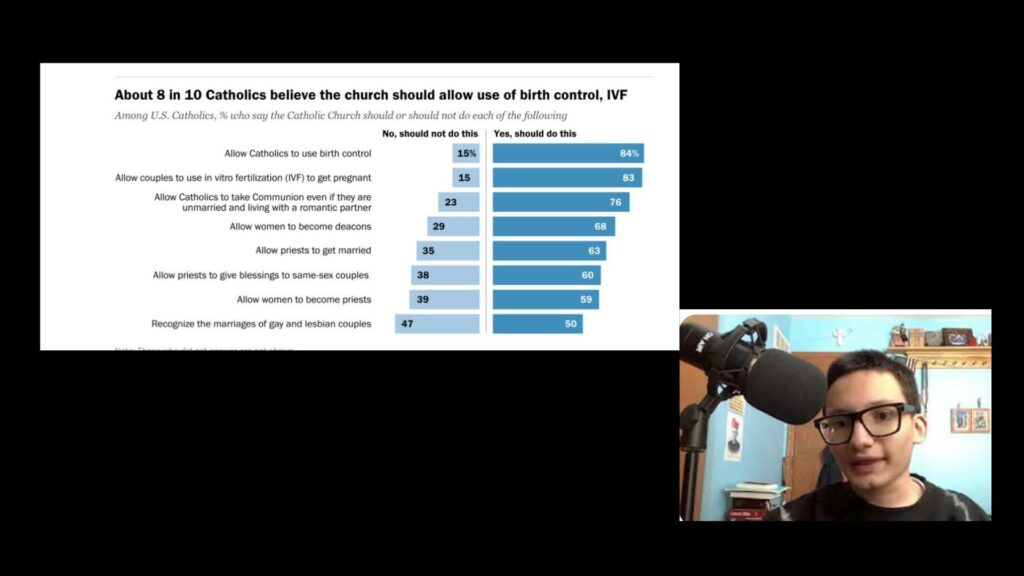
Regardless, the topic of this episode is about a debate I saw online, about the fact that many Catholics do not believe Catholic theology about issues like contraception, IVF, so called same sex marriage, and others.
My mom told me that her morality teacher at her Catholic high school said that “the rules of the church are meant to guide the unguided”. I want to address this issue, since I think it relates very well to the topic of this episode. My theology teacher never said that the church’s moral precepts were simply guidance, rather he said that the church’s morality is based upon divine revelation, the magisterium (which is infallible), and the human conscience.
The first attitude, which seemingly is incompatible with the church’s view of morality, could seem to say that a well-formed conscience has no need of the church’s morality. However the church’s morality is meant to guide the formation of a good conscience. The church’s morality is meant to be a way to guide us to heaven, it is meant not to tell us an arbitrary right or wrong, but right or wrong as God views it.
The ends of this is that a supposedly properly formed conscience can decide that the Catholic ban against abortion could be overlooked if the conscience decides that it is the best option. Of course, this would have to be because of extremely extenuating circumstances, but regardless, this is the ends.
In the end, the point of morality and knowing what is right and wrong, should guard us against doing what is wrong because it violates God’s law. When deciding actions we should not necessarily avoid what is wrong, we should do what is right, what is beneficial for the soul, what is beneficial for the spiritual life. This is the attitude we should have, not, what should I not do, but what should I do. Sometime we do have to avoid wrong and temptation, but our efforts should focus on what is spiritual beneficial, what prayers and works should I do, rather than what acts should I avoid.
We should work on forming a good conscience. But the church is not simply another authority that makes rules like the government. Rather the church is here to interpret God’s laws. This is the Catholic view of ecclesiology, that treats the church as the highest authority in deciding what is right, rather than the individual. Protestant ecclesiology ultimately derives the authority of the church from the individual. The Catholic Church derives her authority from God himself, as Catholics believe that the church was founded by God, by Jesus.
A Catholic forms a good conscience by knowing what the church teaches. Conscience is something that guides man to do good. But a conscience should form itself by the church’s teachings.
I like this way it was put about the knowledge of Catholic theology among the faithful, the youth of the church know better stats of sports and names of celebrities, than they do the words of prayer or melodies of chants. The problem is people simply are not properly Catechized.
Most Catholics know that the church teaches that certain things are wrong. The problem is people don’t understand why the church teaches that these things are wrong, or why they should believe these things are wrong.
The problem is also, most Catholics are lukewarm. They don’t have much care for the faith. Ultimately, why should we care about what morals a person has, if they don’t pray? If they don’t believe the things the church teaches? The principal issue of the church is not that people don’t believe what the church teaches, although that is an issue, undeniably, the problem is, most Catholics are only nominally Catholic, they don’t pray, they don’t attend mass, they live in what you might call practical atheism. You can’t tell a Catholic who calls themselves Catholic from a non-Catholic, one who does not consider themself a member of the church, a member of the secular society.
I have been listening to Reclaiming Vatican II, and it looks at this issue, especially in relation to the “para-council”, who saw Vatican II as a carte blanche to theological liberalism, allowance of contraception, so-called same sex marriage, and other issues. The problem is also priest’s refusal to address these issues from the pulpit. Of course, for Catholics who don’t attend Sunday to Sunday, what difference does it make if priests address these issues from the pulpit, if they are not there to hear it?
The problem then, is the formation most Catholics receive. They understand what the church believes, but often not the underlying why. They understand the faith, but they don’t have an underlying faith to support their beliefs. That’s the problem as I see it. The reason that TLM attendees have a better rate of belief in Catholic doctrine, especially hot-button topics, like the ones mentioned, is because they have a devout faith, supported by a reverent liturgy, and priests who have a devout faith, who love the faith, and are willing to discuss controversial issues, as well as most TLM attendees attend every Sunday.
The same thing is true of other devoutly Catholic places, they have a deep Catholic faith, the church or the faith is the center of their lives, they pray, they go to mass. And because of this they believe in what the church teaches. They understand that the church is how God makes himself present in the world. They understand that the church is God’s revelation.
One problem is with the prevailing culture. The problem is that for most, they understand the culture with which they live, better than they understand their faith. The problem with this is that what the society teaches becomes what people believe and understand, at the expense of ignoring their faith, this is practical atheism. The problem then is that society teaches things contrary to what the church believes especially regarding issues of so called same-sex marriage, contraception, and others. Watch any television show, as Reclaiming Vatican II points out, and you will see, they present society, a society that is antithetical to Catholic beliefs.
People become more familiar with society, especially when these issues are taught in school, or even in Catholic schools, as Fr. Blake Britton, the author of Reclaiming Vatican II points out, he knows of Catholic schools that have LGBT flags and other associations in them.
If we look at it in context of Reclaiming Vatican II, we see that those who lived following the council, as I have said before, took it as a carte-blanche for any theological liberalism they wanted. Which was not the true meaning of the council, but rather an effects of its “spirit”. The “Spirit of Vatican II” that lead to guitar masses, ugly churches, tacky liturgical music and vesture, so on and so forth. As Fr Britton discusses, contraception and sterilization, including by the advice of priests(!), were considered alright, and bans against them were of a “bygone” age, a “pre-enlightened” before Vatican II age. Yet the church has always and consistently taught, including in Vatican II, that contraception was wrong.
The problem is not that the church has changed her teachings. Rather, she has held these beliefs from the beginning. The problem is many of her members, from the clergy, to the faithful, have decided that the church’s teachings do not matter, that the spirit of the age, of the pervading culture is more important than any teaching of the church. Even at the expense of souls.
The church’s rules are not arbitrary. Rather, the church’s rules regarding contraception and abortion, for example, are consistent with the churches beliefs on life. That life is a gift from God, and all life matters from conception to natural death. This is especially true as many places implement euthanasia laws, under the guise of MAID, or Medical Aid in Dying, such as recent laws passed in my home state of Illinois, but already in place in places like Canada. Calling things “end of life care” or “reproductive care”, seeks to humanize these things, normalize them, and sugar coat them. Or so called same-sex marriage, goes against the church’s beliefs of marriage, put simply marriage is between a man and woman, but more than that, marriage is a union of man and woman, created by God, from the beginning. We can understand this in terms of Adam and Eve. But also in terms of in marriage a man and woman share in the love of the Trinity.
The church’s guidelines are revealed by God, understood and taught by the magisterium, and then received into the consciences of the faithful. They are meant to guide the consciences of the faithful, so that the faithful may make good choices, that is, moral choices. The actions of Christians should reflect their Christian life, that they believe in God, that their actions are accounted by him. Ultimately, the actions of Christians should help to build up the kingdom. Their actions do not just matter for the here and now, as if there is nothing to look forward to after. Such is the worldly attitude, the attitude of you only live once, the attitude that one should build up for themselves a great amount of goods and experiences. Rather than that, the Christian attitude is not that these things are unimportant, as this is not a bad attitude to have, it becomes truly a bad attitude only when it justifies sinful acts, or harmful acts.
Ultimately, the attitude of “the church’s rules are only for the unguided”, rather the church’s rules are meant for all the faithful, not only for savages who know nothing. The church’s rules are not only for the uncivilized, but for all who consider themselves Christians. They are not guidance for the unguided, but guidance for all. Just as a compass is not just for the lost, but for all, if you will with an example.
Ultimately, there are a few lessons we should have:
First: We must encourage deeper devotion among Catholics, especially if we wish to have them believe in Catholic morality. This includes, first and foremost, going to mass, as well as praying daily, and going to the sacrament of Confession. Above all, the precepts of the church, considered the “bare minimum” of what a Catholic should do. Ultimately: encouraging a love of the faith. Especially amongst priests, who then are able to encourage this in the families and faithful of their church. Above all, I see it as a cycle, good priests lead to good families, as well good families lead to good priests, it is an important cycle, and each part is important.
Second: A love of the faith must be encouraged, especially among priests. These priests should as well be willing to discuss controversial issues, and stand for what the church teaches. Be it from the pulpit, or when advising a person.
Above all, it is striking to see that a majority of Catholics do not believe in what the church teaches. But it is not surprising. As was pointed out additionally in Reclaiming Vatican II, almost 30% of marriages end in divorce. And while the church teaches against divorce, and not just the church, but Jesus Christ, many in the church are divorced.
To clarify a few things, the church does allow for seperation in cases of abuse. But not for divorce. One time I was aksed, why does the church not allow for divorce, for a person to find “the one they love”. I will answer that question here: that this goes against the church’s belief of love and marriage. Marriage is not finding the one you love, but the one who God has chosen for you. This is not some kind of arranged marriage, but rather, when two people are married this is a covenant that is between God, that cannot be ended by mere human means. Romance and love are not foreign to God’s plan of marriage, but they do not mean it’s end either.
Anyways, I hope you enjoyed this episode, and there will be more exploration into such issues in later time. But I hope this quick and short look was good. God bless and see you next time.
Leave a Reply